LLM's have become a mainstream talking point in the AI space, and this article serves as a reference on how to use them properly, where the backlash comes from, and what it means for you.
LLM's versus LLM Culture
As we've spoken about in previous articles, the launch of ChatGPT in 2022 was, in our opinion, a deeply irresponsible move. Not because LLM's are bad inherently, but because a vast majority of people were never given a container to use the tools properly, and like they are intended to be used.
LLM's have a bad reputation across a certain collective culture because of what else bleeds into it: the theft of intellectual property involved in training some of them, "hallucinations", privacy concerns with the corporations that deploy them, and the reality that some people totally outsource their thinking to them as if they're meant to be some sort of oracle.
That's also not to mention an AI hype culture of "AI-slop", and people relying on LLM's almost exclusively for writing, content creation, and creative arts.
Unfortunately, this creates a large generalization when it comes to LLM's. The sheer noise of this negativity often outweighs grounded conversations on how they can be used effectively. However, we write this article anyway, for there must be some grounding, counter-voice of reason that highlights the real middle ground.
LLM's As Oracles, Not Tools.
A hallmark of what we call the "ChatGPT Culture" is the reality that in 2022: many people turned to these tools, were caught by the allure of not knowing how these systems work — and thought these were to be used as oracles that know everything.
People began to think that it was safe and effective to use these tools for personal matters of the spirit, without any care for 1) what these tools are actually best at, and 2) where their personal data is going during this process.
People saw these tools as infinite knowledge machines, and blurred the lines between a serious tool and a personal companion.
As we touch on in this article, an LLM is nothing more than a newer machine learning tool/technique invented by Google in 2017. It is nothing more than another machine learning artifact in a long line of 60 years of breakthroughs in the space of computer systems. Before the general public ever touched an LLM, they were treated like serious tools. They were embedded into real workflows, they were used to build real systems, and they were used by engineers who fully knew the strengths and limitations of them.
The launch of ChatGPT in 2022 blurred this line by lacking a proper container for people to build literacy, to integrate them properly, and to see them for what they are beyond the hype.
The tool is valuable, but only when you know how to use it.
Prompt the box, "don't make mistakes."
The cultural narrative around LLM hallucinations are overstated relative to where the actual problem comes from.
LLM's by nature are non-deterministic systems. This is what made them revolutionary for the machine learning space. They allowed engineers to step away from hard-coding every single aspect of a logic chains, and to more easily work with more unpredictable datastreams with greater determinism.
These were non-deterministic tools that augmented the ability to work with non-deterministic systems. Suddenly, you could have a machine "infer" something instead of needing a binary input.
That nature is its greatest strength and weakness. The reality is that these systems work best when embedded into something real, practical, and deterministic. The non-deterministic nature of the system must be constrained by something deterministic in order to glean the greatest benefit.
On the other other hand, the ChatGPT culture works as follows: prompt the box, and if it makes a mistake? It's a garbage tool. Understand that it is not inherently designed to be deterministic. The non-determinism is its STRENGTH when embedded properly into the right use case.
The reality is that if you do not know how to use the tool, if you do not know how to contrain it properly to real knowledge bases, filesystems, and workflows, you will only get its weakness.
"An LLM is not AI" is disrespect to Machine Learning at large.
One of the most laughable remarks from those who don't understand machine learning, is the claim that "LLM's are not AI."
It is as if the intent is to shame the very core of LLM's as being insufficient. Sure, they are insufficient for people who don't know how to use them. However, they are plenty sufficient for people who do.
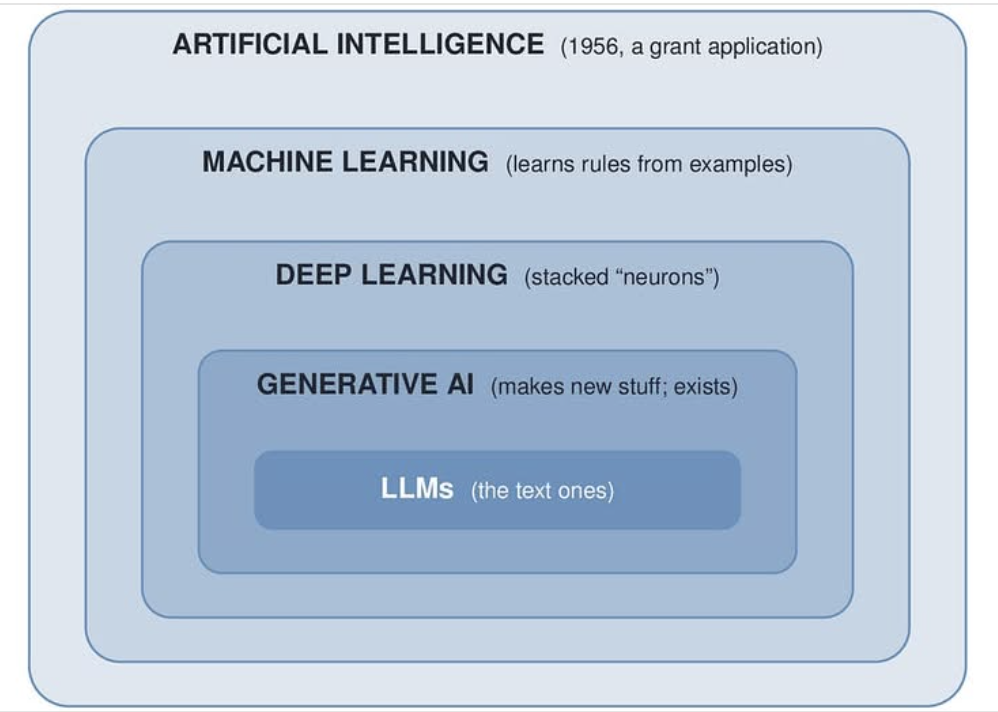
The fact is that an LLM absolutely is "AI". Point blank. However, it is not ALL AI. See the image below.
Cognitive Atrophy Is A Product Of User Behavior. Not The Tool Itself.
This article you read now, written by a human, is proof that not everyone using AI depends on it for writing, wants to use it for creative work, or has any intention of replacing natural human abilities with a machine.
Cognitive atrophy is a real concern with AI, however to see it as anything more than a product of the users behavior, is logic that would not hold up well when examining any other tool or technique in existence.
Anything can be seen for its potential to create atrophy. Driving a car can atrophy your ability to walk. Learning how to handle a a tool-based we@pon can atrophy your ability for tool-less combat.
Use an LLM properly. As a serious tool for automated execution and grounded retrieval, and you are not at risk of atrophy.
Training Data and Intellectual Property
Most LLM's are trained on data that was not given with expressed consent. Major companies have been caught stealing work without the consent of the authors and creators of the original work. That work is then packaged into the core of what the LLM is, and offered as a service for profit to the general public.
The concern about that is absolutely warranted and we will never attempt to defend it.
However it is worth knowing that not every LLM is of the same lineage. In fact, fairly trained AI models exist that were only trained on data that was given expressed permission for inclusion into the model.
These models are only getting better and better as more people start to value them.
Does this change the fact that most models, especially cloud models, are not of this same provenance? No. Most cloud models will likely never create fairly trained models.
However using a fairly trained model will bring some people peace of mind.
Where To Go From Here?
We wrote two manuals for independent AI ownership. These books are about training literacy, and outright, off-cloud AI ownership without cloud middlemen.
We believe every concern with AI is resolved with literacy and ownership. Be it data privacy concerns, hallucinations, and everything else you have less control over when you do not own the actual machine independently.
Until next time.
Endgate Systems
Author written.
Free · Read this first
7 things most people teaching independently owned AI aren’t telling you.
What most instructors leave out, either because they don’t know or because it makes the sale harder. The truth about hallucinations. What security actually means at the machine level. What “local” really is, and what it isn’t.
Until next time.
Endgate Systems
Author written.